⏱ PCR Interval
The Program Clock Reference (PCR) is the 27 MHz timing reference carried in MPEG-TS adaptation fields for the PMT-declared PCR PID. PCR values must appear often enough that decoders can stay synchronized to the encoder clock.
This application applies the maximum interval for the selected MPEG-TS profile:
ATSC:100 msDVB:40 msGeneric:100 ms
What This Test Does
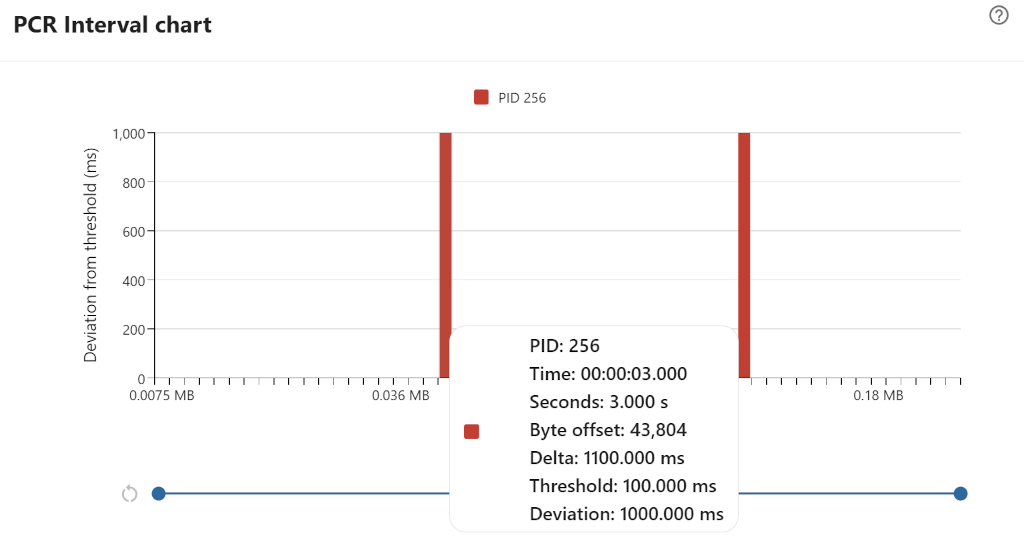
The PCR Interval test scans PCR-bearing packets on the selected PCR PID and records an interval violation when the gap between consecutive PCR values exceeds the selected profile limit.
If a transport packet in that violating span sets the adaptation-field discontinuity_indicator, the finding is still recorded, but the validation result is downgraded to a warning.
✅ Pass Criteria
The test passes when no PCR interval violations are detected.
Application result message:
No PCR interval violations were detected.
⚠️ Warning Criteria
The test reports a warning when every detected PCR interval violation is covered by a discontinuity_indicator on the violating packet or on an earlier packet after the previous PCR sample.
This usually means the stream declared a legal transport discontinuity such as a splice, restart, or timestamp reset.
Application result message:
<n> PCR interval violation was detected, and discontinuity_indicator was set. This is a legal situation.
❌ Fail Criteria
The test fails when one or more PCR interval violations are detected without a matching discontinuity indicator.
Typical causes include:
- Missing PCR packets on the PCR PID
- Mux pacing issues
- Timestamp rewrite or remux defects
Application result message:
<n> PCR interval errors were detected.
Example
Here a chart that shows a PCR interval jump.
Test file
- mpegts-pcr-interval-jump.ts