Amend Local Set
The Amend Local Set, defined in MISB ST 0601 as Tag 101, is used to carry revised metadata without overwriting the original UAS Datalink Local Set.
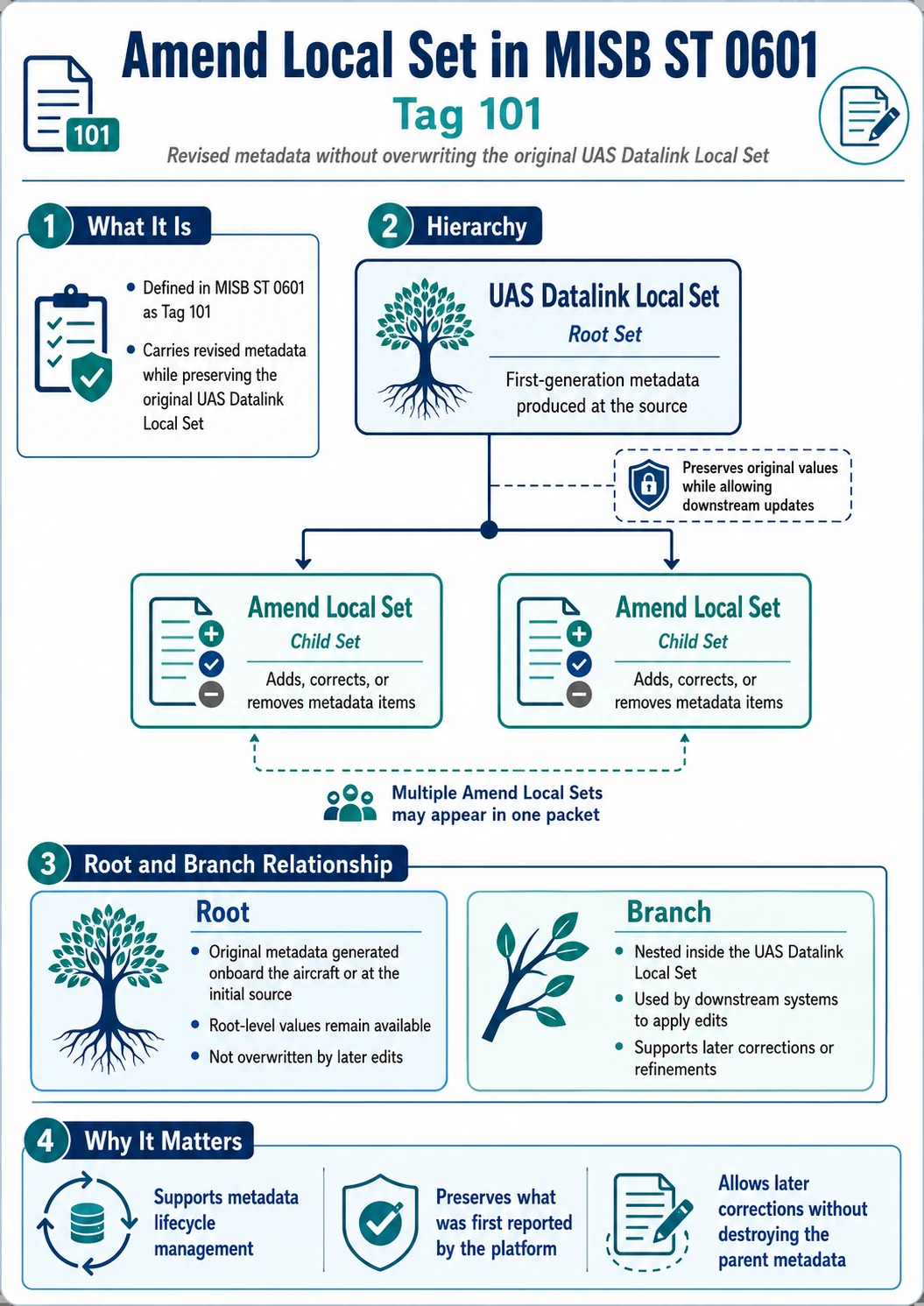
Its relationship to the UAS Datalink Local Set is hierarchical:
- the UAS Datalink Local Set is the root set that carries the first-generation metadata produced at the source
- the Amend Local Set is a child set nested within that root so downstream systems can add, correct, or remove metadata items while preserving the original values
This parent and child structure is intended for metadata lifecycle management. It lets a stream preserve what was first reported by the platform while also carrying later corrections or refinements.
Root And Branch Relationship
Treat the UAS Datalink Local Set as the root of the metadata tree.
- It contains the original metadata generated onboard the aircraft or at the initial source.
- Those root-level values remain available even when later systems need to refine or correct them.
Treat the Amend Local Set as a branch of that tree.
- It is nested inside the UAS Datalink Local Set.
- It exists so later processing stages can apply edits without destroying the original parent metadata.
- More than one Amend Local Set can appear in a packet when different downstream processes need to contribute their own updates.
Inheritance Of Metadata Items
The Amend Local Set does not define an independent catalog of tags.
Instead, it inherits item definitions from the parent ST 0601 metadata model. In practice, that means the same item numbers are reused inside the Amend Local Set when a producer wants to provide a revised value.
For example:
- if a processor wants to provide a corrected sensor latitude, it uses Item 13,
Sensor Latitude, inside the Amend Local Set - if a processor wants to replace another inherited ST 0601 value, it uses that same ST 0601 item identifier inside the child set
The child set therefore changes the value context, not the item vocabulary.
Data Preservation And Interpretation
This structure allows more than one version of a metadata value to travel in the same stream.
- Preservation: the first-generation metadata remains intact in the root UAS Datalink Local Set.
- Correction: the Amend Local Set can carry alternative or refined values for selected items.
- Interpretation: a receiver can choose to interpret the packet as the original parent data alone, or as the combined
Parent + Amendview.
This is especially useful for geo-correction workflows. A post-processing system can add an Amend Local Set containing improved coordinates, attitude values, or related fields while still retaining the raw values originally reported by the aircraft.
Deletion And Nullification
The Amend Local Set is also the mechanism used to delete or nullify inherited parent metadata without changing the root UAS Datalink Local Set.
The receiver model is still hierarchical:
- the parent UAS Datalink Local Set remains the preserved first-generation record
- the child Amend Local Set states which parent values are inherited, replaced, or explicitly cleared for that amendment branch
In practice, deletion has to be signaled explicitly inside the Amend Local Set instance itself.
How To Interpret Presence, Replacement, And Deletion
- If a tag is absent from the Amend Local Set, it is not deleted. The receiver should inherit the value from the parent set.
- If a tag is present in the Amend Local Set with a value, the tag is modified. The receiver should use the amended value instead of the parent value.
- If a tag is present in the Amend Local Set as a zero-length item, the tag is treated as deleted or undefined for that amended substream. The parent value is overridden and treated as unknown or no longer applicable.
This distinction matters because absence and deletion do not mean the same thing. Absence means inherit the parent. Explicit zero-length signaling means the parent value is intentionally nullified for the child branch.
Zero-Length Items
Within MISB metadata, zero-length items are the general mechanism used to signal an undefined or unknown value for items that allow it. In Amend Local Set workflows, that same mechanism is used to indicate that an inherited parent item should no longer apply in the amended view.
Operational details for how deletions are represented in a specific workflow are defined by the Motion Imagery Handbook referenced by ST 1607, rather than by a complete standalone delete procedure in base ST 0601 or ST 1607 alone. For implementation-specific binary handling, that handbook remains the authoritative reference.
Lifecycle-Specific Deletion
Some metadata domains express deletion through a formal lifecycle state rather than only through a generic field-nulling pattern.
For example, in VMTI-oriented metadata, a target can be removed by changing its detection status to Dropped. Once that state is asserted, the target is removed from the active target list and its identifier is no longer retained as an active object.
Summary Table
| Status in Amend LS | Interpretation |
|---|---|
| Tag is absent | Inherit the value from the parent set. The tag is not deleted. |
| Tag is present with a value | Use the amended value instead of the parent value. |
| Tag is present as a zero-length item | Treat the parent value as overridden and undefined for that amended substream. |
Substream Identification With MSID
MISB ST 0601 allows multiple Amend Local Sets to appear in a single packet. To distinguish them, each Amend Local Set must carry a Metadata Substream ID, or MSID, using Item 143.
The MSID rules matter because they preserve lineage across update chains:
- every Amend Local Set must include an MSID that uniquely identifies its substream within the overall metadata stream
- if one Amend Local Set is nested within another Amend Local Set, the producer must preserve the MSID lineage back to the root UAS Datalink Local Set
- receivers use that lineage to determine which update branch a given amended value belongs to
Key Rules
- Nesting: an Amend Local Set can contain child Amend Local Sets, but it cannot contain a Segment Local Set.
- Scope: security metadata at the root UAS Datalink Local Set level defines the overall classification context for all nested Amend Local Set items and their descendants.
- Conformance: metadata may be distributed across root and child levels, but the final union of the root set and all applicable Amend Local Sets still has to satisfy the required items for conformance.
Practical View In STANAG4609 Inspector
When inspecting KLV, it is useful to read the UAS Datalink Local Set as the authoritative original record and each Amend Local Set as a later correction branch.
That mental model helps when you need to answer questions such as:
- which value was reported by the source platform
- which value was inserted by a later correction stage
- whether multiple amendment branches are present in the same metadata packet
- whether the final effective metadata still satisfies the required ST 0601 and profile constraints

In STANAG4609 Inspector, the player exposes this as a practical LS selection for the active KLV packet:
Parent LSmeans the Inspector uses the root ST 0601 local set exactly as carried in the packet.Amend 0,Amend 1, and so on mean the Inspector applies that selected Amend Local Set branch on top of the parent view.
The effective amended view follows normal parent-plus-amend semantics:
- tags not present in the selected Amend Local Set are inherited from the parent local set
- tags present in the selected Amend Local Set replace the parent value for that view
- tags present as zero-length items clear the inherited parent value for that amended view
The selected practical view is then applied consistently across the Inspector surfaces that use packet KLV:
- the KLV packet view shows the effective
ParentorParent + Amendresult - the video overlay and overlay editor use the same selected amend branch for KLV-driven HUD, grid, ruler, marker, and projection-dependent overlay behavior
- the map uses the same selected amend branch, so geospatial reads reflect the same Parent or amended interpretation as the overlay and KLV views
This means the LS selector is not just a display filter. It changes which metadata branch the Inspector treats as effective for the active packet, while still preserving the original parent local set as the authoritative source record.